Places
Multan
About this place
Multan is one of the oldest and most historically significant cities of the Indian subcontinent and one of the great cultural centres of southern Punjab, Pakistan. Located in the heart of the Saraiki cultural region, the city has developed through thousands of years of settlement, trade, agriculture, religious traditions, scholarship, literature and craftsmanship.
Known widely as the "City of Saints" or the "City of Pirs and Shrines", Multan is distinguished by its historic tombs, Sufi shrines, old bazaars, blue-and-green glazed tilework, traditional crafts and distinctive architectural heritage.
The city stands in the southern part of Punjab, close to the Chenab River and within the wider Indus basin. Its geographical position helped make Multan an important centre of agriculture, trade and communication between the Indian subcontinent, Sindh, Afghanistan and Central Asia.
Today, Multan is a major urban and commercial centre of southern Punjab while continuing to preserve many elements of its historic and Saraiki cultural identity.
GEOGRAPHY & LOCATION
Multan is situated in southern Punjab, approximately in the central part of Pakistan's Indus basin.
The district covers approximately 3,721 square kilometres and contains four tehsils: Multan City, Multan Saddar, Shujabad and Jalalpur Pirwala.
The Chenab River lies to the west of the main urban area, while the surrounding plains form part of the fertile agricultural landscape of southern Punjab.
According to the 2023 census, Multan District had a population of 5,362,305 people.
Multan's location has historically been one of its greatest advantages. It lies along routes connecting the upper Indus region with Sindh, the Punjab plains, Balochistan and areas toward Afghanistan and Central Asia.
This geographical position helped transform Multan into a centre of trade, agriculture, religion and scholarship over many centuries.
THE ANCIENT CITY
Multan's earliest history is partly surrounded by legend and uncertainty, but historical sources establish that the city existed long before the arrival of Islam.
The official district history identifies ancient Multan with the city known in classical sources as Maii-us-than and records its conquest by Alexander the Great around 326 BC.
Alexander's campaign in the region encountered strong resistance. According to the traditional historical account, Alexander was seriously wounded during the assault on the city's fortified settlement.
The city's ancient importance was also connected with a major Sun Temple that existed before the arrival of Islam.
The temple became famous in accounts written by travellers and historians and contributed to Multan's reputation as a religious centre and pilgrimage destination.
The ancient city was therefore already an important settlement centuries before the Muslim conquest.
MULTAN & THE CHINESE TRAVELLER
In 641 AD, the Chinese Buddhist traveller Xuanzang, also known as Hiuen Tsang, visited Multan.
His account provides valuable information about the city during the pre-Islamic period.
He described a large and populated settlement surrounded by fertile land and recorded the existence of religious temples, including the famous Sun Temple.
His account demonstrates that Multan was connected to wider networks of travel, religion and scholarship long before the medieval Islamic period.
EARLY MUSLIM CONTACT
Muslim expeditions reached Multan during the seventh century.
The decisive Arab conquest came during the campaign of Muhammad bin Qasim in 712 AD.
Multan was captured after a prolonged battle and subsequently became part of the expanding Muslim territories of Sindh and the lower Indus region.
The city's location made it an important frontier settlement for successive Muslim rulers.
THE HOUSE OF GOLD
Medieval Arab and Persian writers described Multan as an exceptionally wealthy and fortified city.
Some accounts referred to it as the "House of Gold", a description associated with the wealth connected with the city's ancient temple and its position along important trade routes.
Travellers and medieval geographers wrote about Multan's markets, fortifications, religious institutions and surrounding settlements.
The city became an important frontier centre between the Islamic territories of the Indus region and the lands farther east.
GHAZNAVID & GHURID PERIODS
Multan experienced repeated changes of political authority during the tenth and eleventh centuries.
Mahmud of Ghazni captured Multan in the early eleventh century and attacked the city's pre-Islamic religious institutions.
Later, Multan became connected with the wider political structures established by the Ghurids and the Delhi Sultanate.
Its position on the western frontier made it strategically important and also exposed it to repeated invasions from Central Asia.
Despite these conflicts, Multan remained an important centre of commerce, scholarship and religious life.
DELHI SULTANATE & THE MONGOL FRONTIER
During the Delhi Sultanate, Multan became one of the western frontier provinces of the Delhi rulers.
Governors and princes were frequently appointed to defend the city against incursions from Central Asia.
The region experienced repeated Mongol attacks during the thirteenth and fourteenth centuries.
Despite periods of conflict, Multan remained an important centre of commerce, scholarship and religious life.
The city also became closely associated with Sufi scholars whose influence would shape Multan's identity for centuries.
THE SUFI AGE
Multan's modern cultural identity is inseparable from its Sufi heritage.
From the medieval period onward, the city became home to influential Sufi saints, scholars and spiritual teachers.
Among the most important figures associated with Multan are Bahauddin Zakariya, Shah Rukn-e-Alam, Shah Shams Sabzwari and other saints whose shrines remain important religious sites.
Their shrines transformed Multan into one of the major centres of Sufi pilgrimage in South Asia.
The spiritual traditions associated with these saints influenced literature, music, religious scholarship, social life and the cultural identity of the wider Saraiki region.
BAHAUDDIN ZAKARIYA
Hazrat Bahauddin Zakariya was one of the most influential Sufi figures associated with Multan.
Born in 1172 and passing away in 1262, he belonged to the Suhrawardi Sufi tradition.
He established a centre of religious learning in Multan that attracted scholars and students from different parts of the Muslim world.
His shrine remains one of Multan's most important religious monuments.
The legacy of Bahauddin Zakariya also influenced the intellectual history of the region and helped establish Multan as a centre of Islamic scholarship.
SHAH RUKN-E-ALAM
The Tomb of Shah Rukn-e-Alam is perhaps the most recognizable monument of Multan.
Shah Rukn-e-Alam was the grandson of Bahauddin Zakariya and one of the most celebrated Sufi saints of the region.
His mausoleum, constructed in the fourteenth century, is considered one of the finest examples of Indo-Islamic architecture in Pakistan.
The monument is famous for its massive dome, brick construction, timber structure and intricate blue, turquoise and white decorative tilework.
Its architecture became an important symbol of Multan itself.
The tomb stands within the historic Fort Kohna area and remains one of the city's most important places of pilgrimage and heritage.
SHAH SHAMS SABZWARI
Another important Sufi figure associated with Multan is Shah Shams Sabzwari.
His shrine is an important religious site and contributes to Multan's reputation as a city shaped by Sufi traditions.
The shrine and surrounding area remain part of the city's living religious heritage.
LANGA DYNASTY
During the fifteenth century, Multan came under the rule of the Langa dynasty.
Sultan Qutb-ud-Din Langa established himself as ruler of Multan and the dynasty remained influential for approximately eighty years.
The Langa period was significant for trade and agriculture.
Multan became an important caravan centre on routes linking the Indian subcontinent with Kandahar and western regions.
Agriculture expanded along the Chenab and surrounding river systems, while commercial activity increased.
MUGHAL PERIOD
Multan became part of the Mughal political system during the sixteenth century.
Following the establishment of Mughal rule, Multan became one of the empire's important provinces.
During the reign of Akbar and his successors, Multan served as a major administrative and commercial centre.
The province controlled a large territory extending across parts of present-day southern Punjab and neighbouring regions.
The Mughal period brought relative political stability for long periods.
Agriculture expanded, trade flourished and Multan became an important centre for merchants travelling between northern India, Sindh and western territories.
The city also developed further as a centre of Islamic scholarship and architecture.
MULTAN AS A TRADING CENTRE
Multan's geographical position helped it develop into an important trading centre.
Merchants travelled through the city along routes connecting the Indus region with Punjab, Sindh, Afghanistan and Central Asia.
Agricultural products, textiles, handicrafts and other commodities moved through Multan's markets.
This commercial history helped establish the city's long-standing relationship with bazaars and traditional marketplaces.
AFGHAN & SIKH PERIOD
Following the decline of Mughal power, Multan became associated with the Afghan rulers of the region.
The Saddozai rulers governed the region during much of the eighteenth century.
Political conditions became increasingly unstable as regional powers competed for control of the city.
In the early nineteenth century, Sikh forces expanded into southern Punjab.
Maharaja Ranjit Singh's forces captured Multan in 1818 following a major siege.
The historic fort and parts of the city suffered considerable damage during the conflict.
BRITISH PERIOD
Following the Sikh defeat at Multan and the wider annexation of Punjab, the British established control over the region.
The Multan uprising of 1848–49 became one of the important episodes in the British conquest of Punjab.
Multan subsequently became part of British India's Punjab administration.
The British period introduced new administrative structures, transport systems, roads, railways and irrigation infrastructure.
The railway eventually connected Multan with other major cities and strengthened its role as a commercial centre.
MULTAN FORT
Multan Fort, historically known as Fort Kohna Multan, was one of the city's principal defensive structures.
The fort was built on a high mound and contained numerous bastions, gates and defensive works.
The fort contained religious and administrative structures as well as important shrines located within or around the fortified area.
Much of the fort was severely damaged during the 1818 Sikh siege.
Today, the surviving structures and monuments around the fort remain among Multan's most important heritage sites.
MULTANI ARCHITECTURE
Multan developed a distinctive architectural tradition characterized by exposed brick, glazed tiles, geometric decoration, wooden structural elements and large domes.
The city's historic tombs are particularly famous for their use of blue and turquoise decorative tilework.
The architecture developed through interaction between local building traditions, Islamic design and influences arriving from Central Asia and Persia.
This architectural tradition is one of the most recognizable visual expressions of southern Punjab.
BLUE POTTERY & CRAFTS
Multan is internationally associated with its blue pottery and glazed tilework.
Local craftsmen have developed distinctive decorative techniques using blue, turquoise, white and earthy tones.
Traditional pottery includes plates, bowls, vases, tiles and decorative objects.
The designs often incorporate geometric patterns, floral motifs and Islamic-inspired decoration.
Multan is also known for enamel work, embroidery, camel-skin products and other traditional crafts.
These crafts remain an important part of the city's cultural economy.
CAMEL-SKIN CRAFT
Crafts made from camel skin are another traditional art associated with Multan.
Artisans transform prepared leather into decorative lamps, vessels, ornaments and other objects.
These crafts combine practical craftsmanship with intricate painted or embossed decoration.
Along with pottery and tilework, camel-skin products contribute to Multan's reputation as a major handicraft centre.
SARAIKI LANGUAGE & IDENTITY
Multan occupies an important position in the Saraiki cultural and linguistic region.
Saraiki is widely spoken throughout the city and surrounding districts and remains an important language of everyday life, poetry, folk music and cultural expression.
The Multan region has played an important role in the development of modern Saraiki literature.
Poets, writers, researchers and scholars associated with Multan have contributed to the preservation and development of Saraiki literary traditions.
The city's historical relationship with Sufi poetry has also helped connect Saraiki language with spiritual and philosophical expression.
LITERATURE & POETRY
Multan has long been a centre of literary activity.
The city's association with Sufi saints created an environment in which poetry and spiritual writing flourished.
In later centuries, Saraiki, Urdu and Persian literary traditions developed alongside one another.
Khwaja Ghulam Farid, although primarily associated with the Rohi and Mithankot region, is deeply connected with the broader literary and spiritual world of southern Punjab in which Multan occupies a central position.
Modern Multan continues to host literary gatherings, academic institutions, cultural organizations and writers working in Saraiki, Urdu and other languages.
MUSIC & SUFI TRADITIONS
Music is an important part of Multan's cultural life.
Sufi poetry has traditionally been performed through devotional music, qawwali, kafis and folk singing.
The poetry of saints associated with Multan continues to be performed at shrines, cultural gatherings and musical events.
The city also contributes to the wider folk music tradition of southern Punjab and the Saraiki region.
MULTANI BAZAARS
The historic areas of Multan retain the character of an old South Asian trading city.
Traditional bazaars contain shops selling textiles, pottery, handicrafts, religious items, food and household goods.
The old city is closely connected with the historic shrines and remains an important part of Multan's cultural landscape.
The bazaars demonstrate the continuity between the city's historical role as a caravan and trading centre and its modern commercial life.
MULTANI CUISINE
Food is another important part of Multan's cultural identity.
Multani cuisine reflects the wider culinary traditions of southern Punjab.
Wheat, rice, lentils, vegetables, dairy products and meat are important ingredients in local food.
Multan is particularly famous throughout Pakistan for Sohan Halwa.
The sweet is closely associated with the city's identity and has become one of the best-known food products associated with Multan.
Traditional breads, meat dishes, rice dishes, seasonal vegetables and sweets are also part of the local culinary tradition.
MANGOES OF MULTAN
Multan is internationally known for its mangoes.
The district's hot climate and agricultural environment support mango cultivation on a large scale.
Multani mango varieties are widely marketed throughout Pakistan and exported internationally.
Mango production is an important part of the agricultural economy and cultural identity of the region.
AGRICULTURE
Agriculture remains one of the foundations of Multan's economy.
The district is fundamentally an agricultural district, with a large proportion of the population connected directly or indirectly with farming.
Major agricultural products include mangoes, cotton, wheat and other crops.
The district also has agricultural research institutions including the Central Cotton Research Institute, Cotton Research Station and Mango Research Station.
Irrigation, modern farming technology and agricultural research have played important roles in the development of the district's farming sector.
COTTON
Cotton is another major agricultural product of Multan.
The crop has historically been important to the region's economy and contributes to the wider textile industry of southern Punjab.
Multan's cotton research institutions work on developing improved varieties and supporting farmers through agricultural extension services.
Cotton production has also contributed to the development of ginning, textile and related industries.
LIVESTOCK
Livestock is another significant part of the district's rural economy.
Cattle and buffaloes provide milk, meat and other agricultural resources.
The district's livestock sector complements crop agriculture and provides an important source of income for rural households.
CHENAB RIVER
The Chenab River is one of the defining geographical features of the Multan region.
Its waters contribute to the agricultural landscape of southern Punjab and have influenced settlement and farming patterns for centuries.
The riverine environment also supports wildlife, fishing and natural vegetation.
The relationship between Multan and the surrounding river system is one of the reasons agriculture became such an important part of the region's history.
CLIMATE
Multan has a hot, dry climate typical of southern Punjab.
Summers can be extremely hot, while winters are comparatively mild.
The hot climate, combined with irrigation and fertile agricultural land, has contributed to the area's suitability for crops such as mangoes and cotton.
Seasonal temperature changes also influence agricultural cycles and local lifestyles.
NATURAL ENVIRONMENT
Although Multan is primarily an urban and agricultural district, it also contains a range of natural environments.
The riverine areas around the Chenab provide habitats for birds, fish and other wildlife.
Agricultural landscapes support trees, crops and seasonal vegetation.
The surrounding agricultural plains are also characterized by mango orchards and cultivated fields.
EDUCATION & SCHOLARSHIP
Multan has become an important educational centre of southern Punjab.
Bahauddin Zakariya University is one of the city's principal institutions of higher education.
The university traces its institutional history to the University of Multan, established in 1975. It was renamed Bahauddin Zakariya University in 1979 in honour of the city's famous Sufi saint.
The city also contains medical, engineering, agricultural, general education and professional institutions.
Education has strengthened Multan's role as a regional centre for scholarship, research and professional development.
NISHTAR MEDICAL INSTITUTIONS
Multan is also an important medical and healthcare centre for southern Punjab.
Nishtar Medical College was established in 1951 and has developed into one of the major medical education institutions in the region.
Nishtar Hospital provides healthcare services to patients from Multan and surrounding districts.
The institution has played an important role in medical education and healthcare across southern Punjab.
INDUSTRY & ECONOMY
Multan is one of the major economic centres of southern Punjab.
Its economy combines agriculture, manufacturing, commerce, services, transport and handicrafts.
Major industrial activities include cotton ginning, textiles, rice milling, flour milling, paper production, soap and detergent manufacturing, pharmaceuticals, leather products, garments and fertilizer-related industries.
The city's commercial importance also comes from its location within the agricultural heartland of southern Punjab.
TRANSPORT & CONNECTIVITY
Multan is an important transport hub connecting southern Punjab with central Punjab, Sindh, Balochistan and other regions of Pakistan.
The city is connected by major highways and national roads.
Multan Railway Station is an important railway junction on Pakistan's railway network and connects the city with Lahore, Karachi, Rawalpindi, Quetta and other major destinations.
Multan International Airport provides domestic and international air connections and serves as the principal airport for the wider region.
MULTAN INTERNATIONAL AIRPORT
Multan International Airport provides an important connection between southern Punjab and the rest of Pakistan and international destinations.
The airport has strengthened Multan's role as a commercial and travel centre and supports the movement of residents, business travellers and visitors.
Its location makes Multan accessible to a large population across southern Punjab.
RELIGIOUS HERITAGE
Multan's religious heritage extends far beyond individual shrines.
The city contains mosques, tombs, shrines, historic religious buildings and educational institutions connected with centuries of Islamic scholarship.
The concentration of Sufi monuments has given Multan a unique place within the religious geography of Pakistan.
Pilgrims continue to visit the city throughout the year, particularly during annual urs celebrations associated with major saints.
URS & PILGRIMAGE
The annual urs celebrations of Multan's saints are important religious and cultural events.
Large numbers of devotees gather at shrines to offer prayers, listen to devotional music and participate in traditional ceremonies.
These events also create spaces where religious traditions, folk music, poetry, food and community life intersect.
The shrine culture of Multan therefore remains a living tradition rather than simply a historical legacy.
MULTAN AFTER 1947
At the time of Pakistan's independence in 1947, Multan was still largely a traditional city with limited modern infrastructure.
The creation of Pakistan brought major demographic and social changes.
Large numbers of refugees arrived from different parts of India and became part of the city's expanding population.
Over subsequent decades, Multan developed new residential areas, educational institutions, hospitals, roads, markets, industries and public infrastructure.
The city gradually transformed from a historic walled settlement into a major modern urban centre while retaining important elements of its older cultural landscape.
MODERN MULTAN
Modern Multan combines historic neighbourhoods with expanding urban districts, universities, hospitals, shopping areas, industrial zones and modern transport infrastructure.
The city has become an important centre for business, education, healthcare, agriculture, government and regional commerce.
At the same time, its historic shrines, bazaars, crafts and traditional food continue to attract visitors.
This combination of old and new is one of Multan's defining characteristics.
IMPORTANT LANDMARKS
Among the most important places associated with Multan are:
• Tomb of Shah Rukn-e-Alam
• Tomb of Bahauddin Zakariya
• Shrine of Shah Shams Sabzwari
• Multan Fort / Fort Kohna
• Qasim Gate
• Haram Gate
• Bohar Gate
• Delhi Gate
• Hussain Agahi Bazaar
• Ghanta Ghar
• Eidgah Mosque
• Multan Arts Council
• Bahauddin Zakariya University
• Nishtar Medical College
• Multan International Airport
• Historic shrines and old-city bazaars
Together these sites represent different layers of Multan's religious, architectural, commercial and modern history.
MULTAN'S CULTURAL SYMBOLS
Several images have become strongly associated with Multan.
The blue dome of Shah Rukn-e-Alam's tomb is perhaps the most recognizable.
Blue pottery and glazed tiles represent the city's craftsmanship.
Mangoes represent its agricultural identity.
Sohan Halwa represents its culinary tradition.
The shrines represent its Sufi heritage.
The Saraiki language represents an important part of its living cultural identity.
Together these symbols form a distinctive image of Multan.
MULTAN & SARAIKISTAN
For Saraikistan, Multan occupies an important position.
It is one of the major historical, cultural, literary and spiritual centres through which the wider Saraiki region can be understood.
The city's history connects ancient South Asian civilization with Islamic scholarship, Sufi traditions, Mughal administration, Sikh rule, British colonial history and modern Pakistan.
Its bazaars preserve commercial traditions that have existed for centuries.
Its shrines preserve spiritual traditions that continue to attract visitors.
Its poets and writers have contributed to Saraiki and Urdu literature.
Its craftsmen continue traditions of pottery, tilework and decorative arts.
Its agricultural landscape connects the city with the wider rural economy of southern Punjab.
A CITY OF LIVING HERITAGE
Multan's importance does not exist only in its monuments.
Its heritage lives in the sound of Saraiki spoken in homes and markets, in the poetry recited at gatherings, in the devotional music performed at shrines, in the blue patterns painted by artisans, in the mango orchards surrounding the city, in the aromas of traditional food and in the movement of people through its historic bazaars.
The city carries layers of history that can still be experienced in its streets.
Ancient Multan, the medieval frontier city, the Sufi centre, the Mughal province, the Sikh-era stronghold, the British-era district and the modern metropolis all exist as overlapping layers within the same urban landscape.
MULTAN — THE HEART OF SOUTHERN PUNJAB
Multan represents one of the strongest connections between history and living culture in southern Punjab.
From the ancient settlement described by travellers centuries ago to the modern city of universities, industries, hospitals and expanding neighbourhoods, Multan has continually adapted while retaining its distinctive identity.
Its shrines, architecture, language, literature, agriculture, handicrafts, cuisine and traditions make it an essential part of the cultural geography of Saraikistan.
For Saraikistan, Multan is more than a city.
It is a historical crossroads, a centre of Sufi heritage, a home of Saraiki culture, a centre of agriculture and trade, and one of the places where the many layers of southern Punjab's identity come together.
Multan's story is ultimately a story of continuity — a city that has witnessed empires rise and fall, religious and cultural traditions evolve, trade routes change and modern Pakistan emerge, while continuing to preserve the cultural memory of the region around it.
Gallery
Photos
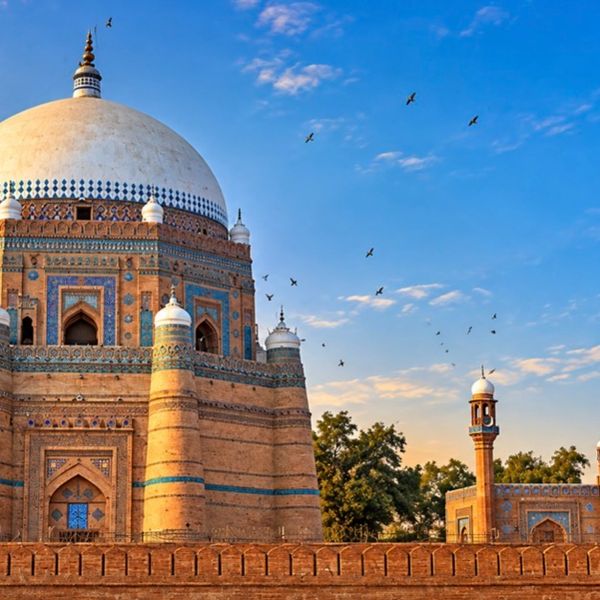
Image Credits+
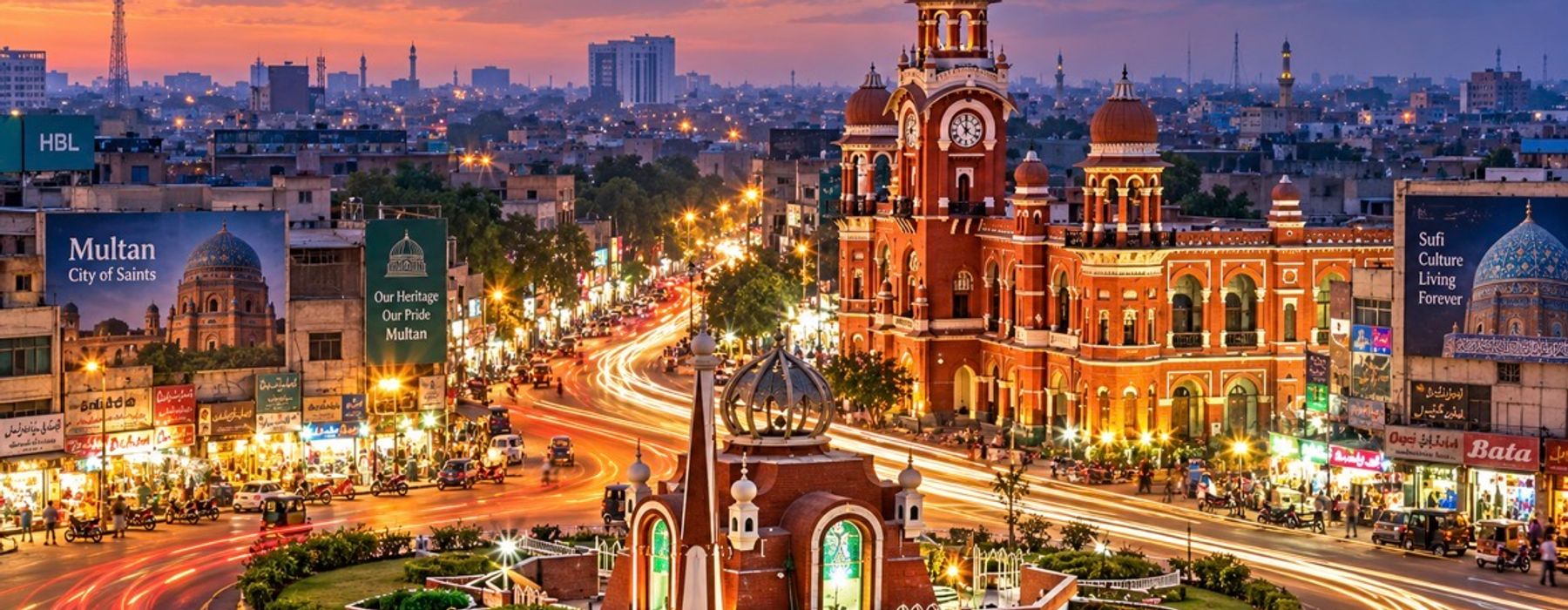
AI-GENERATED IMAGE COVER PICTURE AI-generated cover artwork created for Saraikistan using a reference photograph supplied for this place profile. The final image is AI-generated and is not an original documentary photograph.